
TL;DR:
- Authenticity in songwriting is the perception of genuine expression through lyrics, performance, and production. Listeners evaluate cues like raw vocals and specific storytelling to determine if a song feels sincere.
Authenticity in songwriting is defined as the perceived genuineness, sincerity, and originality an artist expresses through lyrics, performance, and production. The role of authenticity in songwriting goes beyond raw emotion or unpolished delivery. It functions as the coherent alignment between what an artist feels, how they say it, and what listeners recognize as real. Research from Ballantine’s True Music shows that 90% of music fans say authenticity is the most important factor for connecting with an artist. That figure signals something the pop industry cannot afford to ignore: listeners are not passive. They are actively evaluating whether what they hear feels true.
What does authenticity in songwriting actually mean?
Authenticity in music is not a fixed quality. It is a perception, and that perception is shaped by emotional resonance, artistic integrity, and originality working together. A song can be produced to radio perfection and still feel honest if the message, delivery, and listener expectations align. Conversely, a stripped-back acoustic track can feel hollow if the lyrical language rings false. The distinction matters because songwriters often conflate rawness with truth, when the two are not the same thing.
Adele’s Someone Like You is a useful reference point here. The song’s power does not come from lo-fi production. It comes from lyrical specificity, a vocal delivery that sounds like it costs something, and a narrative that listeners recognize from their own lives. That combination creates what researchers call perceived sincerity, which is the audience’s conclusion that the artist is not performing a version of emotion but actually inhabiting it.
Authenticity is also, importantly, a two-way process. Listeners assess an artist’s trustworthiness and inner life from artistic commitments made across a body of work, not just a single song. This means authenticity builds over time, and it can erode just as gradually.
How do listeners decode authenticity cues?
Listeners do not evaluate authenticity through a checklist. They use what researchers describe as authenticity heuristics: observable stylistic cues that signal whether a song feels genuine. These cues operate below conscious awareness for most listeners, but they are consistent and learnable for songwriters.
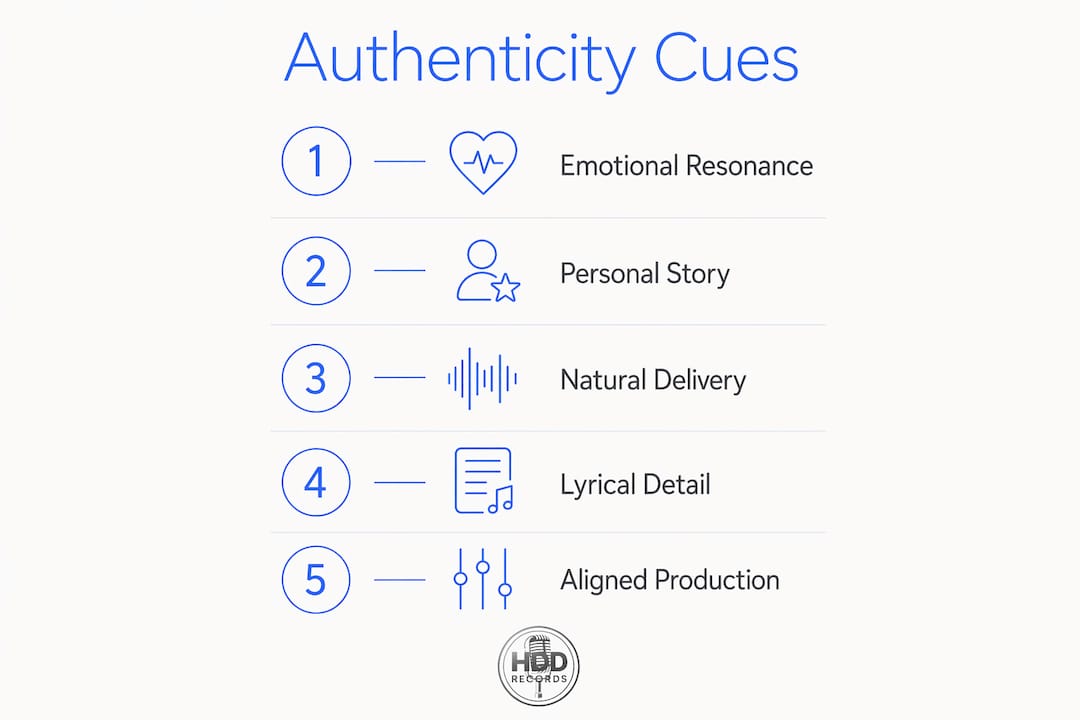
The most recognized authenticity cues in pop songwriting include:
- Raw or emotionally exposed vocal delivery that sounds like effort, not ease
- Personal storytelling grounded in specific detail rather than universal platitude
- Natural, conversational language that does not strain for poetic effect
- Production choices that serve the emotional core rather than mask it
- Consistency between lyric perspective and performance style
The risk of ignoring these cues is real. Stiff or over-polished language causes listener disengagement before the hook even lands. A lyric that sounds written rather than felt breaks the spell immediately. Songwriters who chase trend-adjacent phrasing often produce work that sounds current but feels borrowed.
The subtler danger is overcorrection. Trying too hard to sound raw, vulnerable, or unfiltered reads as performance. Listeners are attuned to the difference between a private bruise and a staged wound. Authenticity heuristics work precisely because they are inferred from repeated cues across a song, not manufactured in a single moment.
Pro Tip: Record a rough voice memo of yourself speaking about the song’s subject before writing a single lyric. The words you use in that unguarded moment are almost always more honest than anything you will craft at a keyboard.
How do you balance vulnerability and structure in songwriting?
Vulnerability is the engine of authentic songwriting, but unstructured vulnerability is not a method. It is a risk. Research on structured songwriting interventions shows that unstructured emotional expression in songwriting can increase anxiety rather than relieve it. Meaningful personal expression needs boundaries to remain psychologically safe and artistically effective.
For songwriters, this means building a session structure that holds emotional honesty without letting it collapse into overwhelm. A practical framework looks like this:
- Set a clear emotional prompt. Choose one specific feeling or memory, not a general theme. “The morning after a breakup” is more useful than “heartbreak.”
- Write without editing for ten minutes. Get the raw material on the page before the critical voice arrives.
- Identify the one line that feels most true. That line is usually the emotional center of the song.
- Build structure around that center. Let the verse contextualize it, the chorus amplify it, and the bridge complicate it.
- Revise for clarity, not polish. The goal is to make the truth legible, not to make it shine.
This approach preserves the emotional honesty that listeners respond to while giving the songwriter a container that prevents the session from becoming destabilizing. Emotional honesty anchored with structure is the condition under which authentic songwriting is both sustainable and effective.
Pro Tip: Treat the revision stage as translation, not improvement. You are translating raw feeling into language that a stranger can feel. The goal is not a better sentence. It is a truer one.
How to write authentic lyrics in pop music
Pop songwriting presents a specific tension. The genre demands accessibility, repeatability, and hooks that work across millions of listeners. Authentic expression, by contrast, is often particular, idiosyncratic, and personal. The craft lies in making the specific feel universal without flattening it into the generic.
Use lived-in detail, not summary
The most effective authentic pop lyrics contain details that could only come from one person’s experience. Not “I was sad when you left” but the specific object, place, or moment that carries that sadness. Specificity creates the paradox of pop: the more precise the detail, the more listeners feel it applies to them. This is the narrative instinct that separates memorable songwriting from competent songwriting.
Write choruses as real-time decisions
Listeners connect most strongly to lines that feel like real-time emotional decisions rather than retrospective recaps. A chorus that sounds like the singer is choosing something in the moment carries more weight than one that summarizes what already happened. The difference is grammatical as much as emotional: present tense, active voice, and direct address all signal immediacy.

Align production with message
Song authenticity is decoded through lyric detail, vocal delivery, and production style as a collective system. A lyric about grief set over a euphoric club beat creates cognitive dissonance unless the contrast is intentional and earned. When production choices contradict the emotional message without purpose, listeners register the mismatch as insincerity, even if they cannot name it.
The following elements work together to signal authentic pop songwriting:
- Lyric perspective that matches the singer’s actual emotional position
- Vocal takes that preserve imperfection where it serves the feeling
- Arrangements that leave space for the lyric to breathe
- Production textures that reinforce rather than decorate the emotional core
What innovative techniques strengthen authentic songwriting?
Authentic expression does not require conventional song structure. Breaking form can itself be an act of honesty, particularly when the standard verse-chorus-bridge model does not fit the emotional shape of what the songwriter is trying to say. Songwriter Jackson Cannon describes the best pathway to authenticity as writing raw and as personable as possible, which sometimes means resisting the pull toward familiar structures that feel safe but ring hollow.
Techniques that strengthen authentic expression in pop songwriting include:
- Genre blending with intention. Mixing dance-pop with confessional folk, or disco with introspective balladry, creates sonic contrast that mirrors emotional complexity. Morgan Harris does this across his catalog, placing emotionally driven storytelling inside club-facing production without letting either element cancel the other.
- Preserving spontaneous moments. A cracked note, a breath in the wrong place, or an unplanned lyric variation in a vocal take can carry more emotional weight than a technically perfect performance. These imperfections function as unscripted moments that listeners find unforgettable.
- Selective collaboration. Co-writing works best when a collaborator sharpens rather than replaces the songwriter’s voice. The test is whether the finished lyric still sounds like it could only have come from one specific person.
- Originality checks during revision. Reading lyrics aloud and asking whether any line could appear in a hundred other songs is a simple but effective filter. If the answer is yes, the line needs to go deeper.
The authenticity heuristics framework is useful here because it reminds songwriters that every stylistic choice sends a signal. Innovative techniques only strengthen authenticity when they are consistent with the emotional message the song is trying to deliver.
Key Takeaways
Authenticity in songwriting is the coherent alignment of emotional truth, lyrical specificity, vocal delivery, and production, perceived and evaluated by listeners through observable stylistic cues.
| Point | Details |
|---|---|
| Authenticity is a perception | Listeners decode genuineness through repeated stylistic cues, not just artist intent. |
| Specificity creates universality | Lived-in lyric detail makes songs feel personal to millions, not just the writer. |
| Structure protects vulnerability | Anchoring emotional honesty in session structure prevents psychological strain and improves output. |
| Production must align with message | Mismatched production and lyric emotion registers as insincerity, even unconsciously. |
| Rawness is not the same as truth | Authentic songwriting is coherent alignment, not the absence of polish. |
Authenticity as a moving target: an editorial view
The conversation around authentic songwriting tends to flatten into two camps: those who treat rawness as a virtue in itself, and those who dismiss the concept as a marketing construct. Neither position holds up under scrutiny.
What I find more accurate, and more useful for working songwriters, is that authenticity is a moving target. It is shaped by what listeners have already heard from an artist, what the genre context signals, and what the cultural moment rewards. An artist who was celebrated for confessional directness in one era can be perceived as self-indulgent in another, without changing a single creative habit. This is not cynicism. It is the reality of how perception works.
The practical implication is that songwriters cannot simply be authentic and expect the work to land. They have to be legible. The emotional truth has to be expressed in a form that listeners can receive. That is a craft problem, not a sincerity problem. The artists who navigate this best, including those working in pop and disco-pop where the theatrical lift of the genre can obscure personal content, are the ones who treat authenticity as a discipline rather than a default. They make deliberate choices about which details to include, which vocal takes to keep, and which production textures serve the song’s emotional argument. The storytelling principles that make fiction impossible to put down apply here with equal force: specificity, stakes, and a narrator the audience trusts.
Emerging artists face the additional pressure of industry expectations that reward trend alignment over personal voice. The artists who resist that pressure most effectively are not the ones who ignore commercial reality. They are the ones who find the overlap between what is true for them and what is true for a wider audience, and they write from that intersection with precision.
— Luca Bennett
Morgan Harris and the practice of authentic pop

Morgan Harris represents a working example of what authentic pop songwriting looks like in practice. His catalog, released through HDD Records, places emotionally driven personal storytelling inside dance-pop and disco-pop production without sacrificing either the club-facing energy or the confessional core. Tracks like Blues In The Summertime, Pictures Back, and XXI each carry the kind of lyric specificity and vocal commitment that listeners register as genuine. His approach to authentic pop songwriting treats the dance floor as a stage for complicated feeling, not an escape from it. For songwriters and music enthusiasts who want to hear these principles applied across a full catalog, Morgan Harris’s official music pages offer a direct and instructive listen.
FAQ
What is the role of authenticity in songwriting?
Authenticity in songwriting creates a genuine emotional connection between artist and listener by expressing sincere, original experiences through lyrics, performance, and production. It is perceived through observable stylistic cues rather than artist intent alone.
How do listeners recognize authentic songs?
Listeners use authenticity heuristics, including raw vocal delivery, personal storytelling, and natural conversational language, to infer whether a song feels genuine. These cues are evaluated collectively across lyric, vocal, and production layers.
Does authentic songwriting require avoiding polished production?
No. Authenticity can coexist with polished production when the message, delivery, and listener expectations align coherently. The absence of polish does not guarantee sincerity, and high production quality does not prevent it.
How does vulnerability fit into authentic songwriting?
Vulnerability is central to authentic songwriting, but it works best when anchored in session structure. Unstructured emotional expression can increase anxiety, while structured approaches preserve emotional honesty and psychological safety.
What makes a pop lyric feel authentic?
Pop lyrics feel authentic when they contain specific, lived-in detail, use natural conversational language, and present emotional decisions in real time rather than as retrospective summaries. Generic or trend-chasing phrasing consistently weakens perceived sincerity.